How to Shop at an Independent Stationery Store: A Paper Lover's Checklist
October 31, 2026 - Stationery

October 22, 2026 - Daily Practice
Most people who stop journaling do not stop because they ran out of things to say. They stop because the habit they built was too heavy to carry. A page that began as a place to think turns into a small daily debt, and after a week of missed payments the notebook goes in a drawer.
The fix is rarely more discipline. It is usually a smaller, more forgiving version of the practice. Below are the mistakes that quietly end most journaling routines, and the plain adjustments that keep the pen moving.
Perfectionism in a journal rarely looks dramatic. It looks like a pristine notebook and a first page you are afraid to spoil. It looks like crossing out a sentence because the handwriting slanted, drafting a paragraph in your head before committing it to paper, or rereading yesterday's entry and deciding it sounded foolish.
The cost isn't just time. It's that the journal stops being a place to think and becomes a place to perform. Once that happens, you only write when you think you have something good, which is the same as not writing at all.
Messy handwriting is not a sign that the practice is failing. It is a sign that you were moving faster than your doubt.
This is the most common trap, and it is easy to spot. You sit down at ten at night meaning to describe the whole day: the meeting, the email you shouldn't have sent, the phone call with your sister, the thing you forgot at the shop. Six minutes later you have two paragraphs, no conclusion, and no interest in continuing. Tomorrow you skip it, because you know how long it takes.
A journal is not a log. You are allowed to leave most of the day out. Choose one thing and give it four or five sentences instead of trying to fit everything into twenty.
Two rules make this practical. First, write the detail you would otherwise forget: the exact way someone phrased a complaint, the colour of the sky on the walk home, the sentence you almost said out loud and didn't. Second, stop mid-sentence if the time is up. Picking up a half-finished thought is far easier than starting from a blank page.
If you genuinely want to capture more, spread it out. Three sentences while the kettle boils, two lines after lunch, one observation on the bus. Short entries collected across a day read better than a tired summary written at midnight.
Plenty of people only open the notebook when something significant happens. A promotion, an argument, a decision. The ordinary Tuesday, with its weather and its small irritations, feels unworthy of ink.
The result is two entries a month and no momentum. And the significant days, oddly, end up under-described, because you never built the habit of noticing small things well enough to describe them.
Concrete detail ages better than summary. "A hard day" is worth nothing in six months. "I ate lunch standing up and could not remember whether I had answered Marta" is worth something.
Counting consecutive days is motivating for about a fortnight. Then you get a cold, or work runs late, or you fall asleep on the sofa, and the chain breaks. Many people never recover from that first gap. The notebook feels like evidence of a failure rather than a tool.
Change the unit of success. Instead of "every single day, forever," try "four entries a week." That target survives a bad Tuesday. It also removes the strange guilt of writing twice on a Sunday to catch up.
When you return after a gap, use a re-entry line and nothing more: Back after nine days. Here is what I noticed. No apology, no explanation, no summary of the absence. The gap does not need to be atoned for.
Colour-coded spreads look wonderful online and take twenty-five minutes to set up. Gratitude lists, morning pages, mood trackers, thirty-day prompt challenges: each is fine on its own, and taken together they turn a ten-minute habit into a project.
Pick one format and keep it for a month. If you have low energy in the evening, choose something short. If you write in the morning with coffee, you can afford more.
Prompts are useful when you are stuck and harmful when they become homework. Keep a short list of five you like and ignore everything else.
Habits survive on ease. A journal in a drawer behind a stack of papers, a pen that has run out, a phone face-up on the table: each of these adds a few seconds of resistance, and a few seconds is all it takes for a fragile routine to lose.
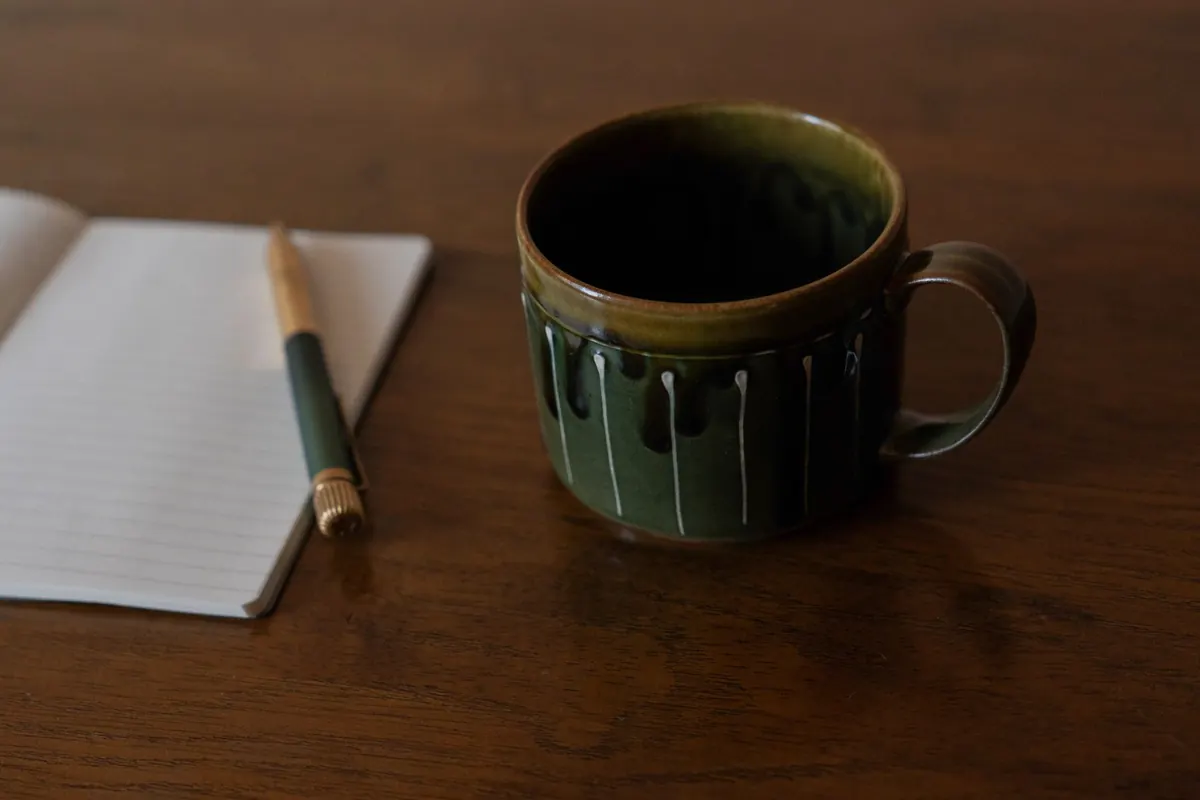
Keep the notebook where you already sit and think. On the kitchen table next to the coffee. In the bag you carry every day. On the chair beside the bed, open at the next blank page. Clip one working pen inside the cover so there is never a search. Put the phone in another room for the first five minutes, or turn it face-down and out of reach.
You do not need a writing desk, a candle, or a particular chair. A journal written at the kitchen counter counts exactly the same as one written in a study.
A journaling habit is not tested on quiet Sundays. It is tested in the week when three things go wrong and you are too tired to think in full sentences. Plan for that week now, while you have the energy.
Expect the routine to wobble. You will miss days, write dull entries, and occasionally go a fortnight without opening the cover. None of that undoes the practice. The only version of journaling that fails is the one that has to be perfect to continue, so keep it small, keep it within reach, and let the ordinary days in.
Photo: 道然 澄 / Pexels

A practical checklist for shopping at independent stationery shops: how to test paper, ask the right questions about...
A practical comparison of brush pens and dip pens for new calligraphers, covering control, setup, cleanup, cost and...
Copyright © 2026 Amanuense Ogni Giorno. All Right Reserved.